Galileo Campus
Bloomingdale International School Road PenamaluruEarly Years Village Campus
Municipal Employees Colony Main Road
Galileo Campus
Bloomingdale International School Road PenamaluruEarly Years Village Campus
Municipal Employees Colony Main Road
Share article:


Friday, June 26, 2026
by Bloomingdale International School
For decades, Indian parents asked a fairly straightforward question when choosing a school: "Will this school help my child score well?" Today, parents are asking something very different. "Will my child be ready for a world that is changing faster than ever before?"
It is a question many families find themselves thinking about more often. Artificial intelligence is reshaping industries. Career paths are evolving. Universities are looking beyond marks. Employers are increasingly valuing communication, creativity, collaboration, adaptability, and problem-solving alongside academic achievement.
According to the World Economic Forum's Future of Jobs Report, analytical thinking, resilience, leadership, curiosity, and creative problem-solving are among the fastest-growing skills required in the modern workforce. This creates an important challenge for schools. How do we continue providing strong academic foundations while also preparing children for a future that none of us can fully predict?
At Bloomingdale International School, that question led to the creation of iCBSE. iCBSE is not a new board. It is not CBSE with a few extra activities added on. It is a next-generation learning model that combines the academic strength of CBSE with the inquiry, creativity, real-world application, and future-focused learning experiences that children need to thrive in the years ahead.
 One of the strongest themes throughout the BIS vision framework is that education should not stop with information transfer. Children should not spend years memorising content only to forget it after examinations. Instead, they should understand ideas deeply, connect them to real situations, and learn how to use knowledge meaningfully. This belief sits at the centre of the iCBSE approach.
The BIS vision framework states that teaching and learning should foster creativity, critical thinking, innovation, and holistic development through design thinking, interdisciplinary learning, and project-based experiences. In practice, this means students do not simply study concepts. They experience them.
A science lesson may connect with technology and design. A humanities project may lead students to solve real-world community challenges. Art, innovation, communication, and problem-solving are integrated into the learning journey rather than treated as separate activities. The goal is simple. Children should leave school knowing not only what they learned, but why it matters.
Must Read: What is the difference between IB Board vs CBSE?
One phrase appears repeatedly throughout the BIS vision and philosophy:
Creators. Designers. Performers.
Bloomingdale School's mission is to help every child discover the intelligence, creativity, versatility, and potential already within them. This is why iCBSE focuses heavily on creating opportunities for students to build, create, design, perform, explore, present, and innovate. The framework specifically describes every BIS learner as a creator, designer, and performer. Parents often worry that creativity comes at the expense of academics.
At BIS, the philosophy is different. Creativity strengthens learning. When children create something meaningful, they engage more deeply with concepts, remember them longer, and become more invested in their own learning journey.
One of the most distinctive parts of the iCBSE model is its Design Thinking approach. Students are encouraged to see challenges as opportunities rather than obstacles. Curiosity becomes the starting point for investigation, experimentation, and problem-solving.
Instead of immediately asking: "What is the correct answer?"
Students learn to ask: "Why does this problem exist?" "How can it be improved?" "What solutions might work?"
These habits gradually develop independent thinking and confidence. The BIS framework describes this as transforming curiosity into practical solutions, making learning both engaging and relevant. For parents, this means children become active participants in learning rather than passive receivers of information.
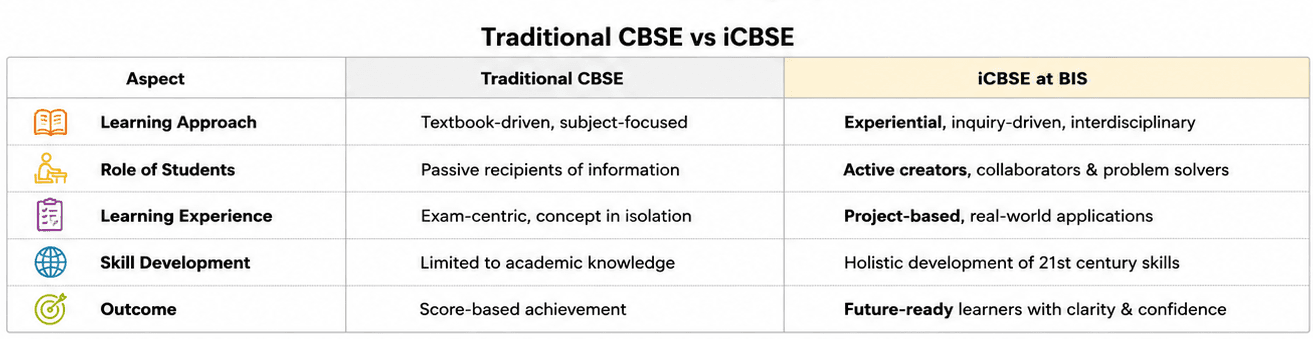 The difference is not found in the syllabus. The difference is found in how students experience learning. While the CBSE curriculum provides a strong academic foundation, iCBSE extends learning through Project-Based Learning, Design Thinking, Interdisciplinary Projects, Community Engagement, Goal Setting, Mentorship, Career Counselling, Sports Excellence, Arts Integration, and Well-being programmes.
The academic year itself is structured around thematic units that culminate in interdisciplinary projects. Students connect science with design, humanities with service, and technology with real-world applications. This helps students see learning as interconnected rather than divided into isolated subjects.
 Perhaps the strongest section of the BIS framework is its Learner Personas. Rather than defining success purely through examination scores, BIS asks a different question:
"What kind of human being do we want our students to become?"
The answer includes learners who are explorers, thinkers, communicators, creators, collaborators, reflectors, ethical decision-makers, empathetic individuals, and resilient problem-solvers.
Similarly, the admissions framework describes five core outcomes. Students become self-directed learners, effective communicators, collaborative leaders, strong thinkers, and community builders.
These qualities influence every aspect of the learning experience. Because ultimately, schools do not simply produce graduates. They help shape future citizens, professionals, leaders, and community members.
One of the biggest misconceptions about modern education is that everything valuable happens inside a classroom. The BIS framework challenges this idea directly.
Sports are viewed as opportunities to build discipline, teamwork, resilience, confidence, and perseverance. Arts develop creativity, cultural awareness, self-expression, and critical thinking. Community engagement develops empathy, responsibility, leadership, and social awareness. These experiences are not treated as extracurricular additions.
They are considered essential parts of student development. This reflects the school's belief that future-ready individuals need more than academic knowledge alone. They need character.
One of the strongest advantages of the iCBSE journey is that students gradually gain clarity about themselves. Through projects, leadership experiences, sports, arts, mentorship, and community engagement, students begin discovering what interests them, what strengths they possess, what motivates them, and where they may wish to go next.
This naturally connects to the BIS career counselling framework, where students receive guidance on career exploration, subject selection, university pathways, and future planning. By the time students leave school, the goal is not simply qualification. It is clarity.
Perhaps the easiest way to understand iCBSE is this. It keeps the academic strength of CBSE. But it expands the definition of success. Success is not measured solely by examination scores. Success is also reflected in confidence. In communication, resilience, leadership, creativity, and empathy. In the ability to adapt, contribute, and continue learning throughout life.
At Bloomingdale International School, that is what iCBSE is designed to achieve. Because the most important question for parents may no longer be "What board should I choose?" The more meaningful question may be "What kind of person do I want my child to become?"
Must Read: How to choose a school?
iCBSE is Bloomingdale International School's integrated CBSE learning model that combines strong academics with design thinking, project-based learning, leadership, creativity, mentorship, sports, arts, and future-ready skills.
iCBSE goes beyond textbook learning by integrating real-world projects, interdisciplinary learning, community engagement, learner personas, mentorship, and career guidance while maintaining the academic rigour of CBSE.
Yes. iCBSE builds strong conceptual understanding, analytical thinking, problem-solving, and application-based learning, skills increasingly important in modern competitive examinations.
iCBSE develops self-directed learners, communicators, thinkers, creators, collaborators, leaders, and community builders who are prepared for university, careers, and life beyond school.
BIS introduced iCBSE to combine the academic strength of CBSE with the future-ready skills, global outlook, and learner-centred philosophy that modern students need to succeed in a rapidly changing world.
Bloomingdale International School is recognised by many families for its iCBSE model, which combines the academic rigour of CBSE with project-based learning, mentorship, design thinking, arts, sports, and future-ready skill development.
Parents should evaluate more than examination results. Factors such as teaching quality, student well-being, mentorship, sports, arts, leadership opportunities, and future-ready learning experiences often provide a more complete picture of a school's quality.