Galileo Campus
BIS Road, Behind AP Fisheries, Poranki, VijayawadaEarly Years Village Campus
Municipal Employees Colony, Acharya Ranga Nagar, Benz Circle, Vijayawada
Galileo Campus
BIS Road, Behind AP Fisheries, Poranki, VijayawadaEarly Years Village Campus
Municipal Employees Colony, Acharya Ranga Nagar, Benz Circle, Vijayawada
Share article:


Thursday, June 11, 2026
by Bloomingdale International School
For many Indian parents exploring the IB Diploma Programme, one question eventually becomes more important than the curriculum itself: What actually happens after IB?

The concern is understandable. Parents are not only evaluating school education anymore. They are trying to understand whether the pathway their child enters at sixteen or seventeen will genuinely support university admissions, career flexibility, emotional confidence, and long-term readiness for a changing world.
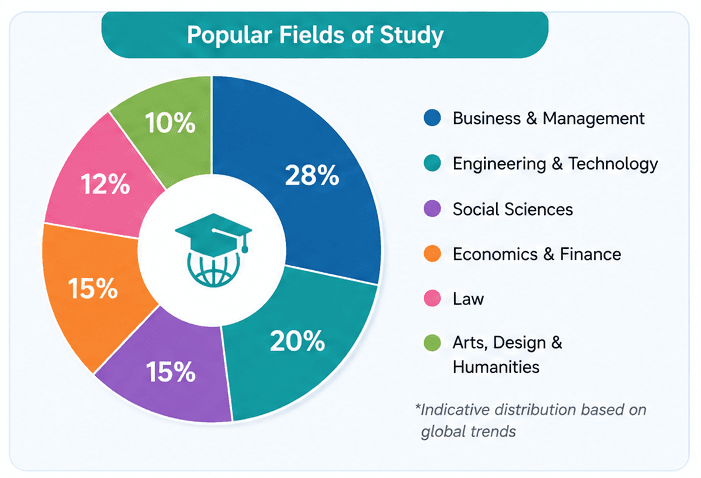
The good news is that Indian IB Diploma graduates today pursue higher education across both Indian and international universities at a rapidly growing scale. Students move into universities across the United States, the United Kingdom, Canada, Singapore, Australia, Europe, and increasingly, leading Indian institutions as well. Many pursue business, economics, law, engineering, liberal arts, psychology, design, media, technology, and interdisciplinary programmes that combine multiple fields.
Yet the biggest advantage of the IB pathway is not tied to one country or one university system alone. It is flexibility.
Students completing the IB Diploma are rarely restricted to a single academic direction. They are often able to apply simultaneously across Indian universities, international universities, liberal arts programmes, STEM-focused pathways, business schools, and creative disciplines. This flexibility has become one of the strongest reasons Indian families are increasingly considering IB education for long-term academic planning.
The global higher education landscape has changed dramatically over the last decade. Universities today are not simply evaluating examination marks in isolation. Increasingly, institutions are assessing analytical thinking, communication ability, research exposure, leadership experiences, interdisciplinary understanding, and student initiative. This shift aligns naturally with the IB Diploma structure.
Indian universities themselves are also evolving. Institutions such as Ashoka University, FLAME University, Krea University, and O.P. Jindal Global University increasingly evaluate broader student profiles rather than marks alone. This has made the IB Diploma more compatible with Indian higher education than many parents previously assumed.
At Bloomingdale International School, this changing university landscape forms an important part of counselling conversations with families. Parents increasingly want children to remain academically strong while also developing confidence, communication ability, adaptability, and clarity about future pathways.
One of the strongest advantages of the IB Diploma is global recognition. Because universities across the world already understand the curriculum, students can apply internationally without needing to completely shift their academic learning style or approach to education.
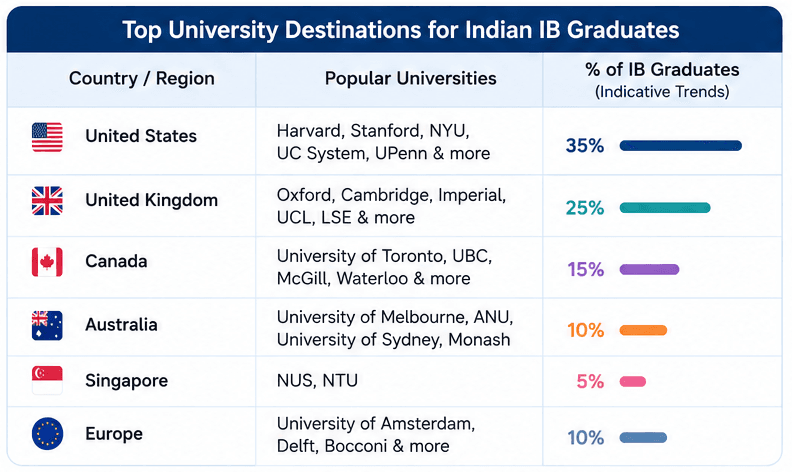
The United States continues to remain one of the most preferred destinations for Indian IB students. Universities such as Harvard University, Stanford University, New York University, the University of Pennsylvania, and the University of California System regularly receive applications from IB students because American universities typically value holistic student development alongside academics. IB students often adapt naturally to these systems because inquiry-led learning, presentations, independent research, and project-based experiences are already familiar parts of their school education.
The United Kingdom is another major destination. Universities such as the University of Oxford, the University of Cambridge, Imperial College London, University College London, and the London School of Economics have long been familiar with the IB Diploma and often publish IB-specific score requirements directly through the UCAS admissions system. Many Indian students pursue economics, engineering, law, political science, business, and medicine through UK pathways because the analytical writing and research orientation of the IB aligns closely with British higher education expectations.
Canada has also become increasingly popular among Indian IB students over the last decade. Families are often attracted to the balanced student environment, research-focused universities, and supportive international student systems. Universities such as the University of Toronto, University of British Columbia, McGill University, and University of Waterloo commonly receive applications from IB students. Many Canadian universities also recognise Higher Level IB subjects for advanced standing or transfer credits.
Australia, Singapore, and several European countries are similarly becoming attractive pathways for Indian IB students. Universities such as the University of Melbourne, the Australian National University, the National University of Singapore, Nanyang Technological University, the University of Amsterdam, and Delft University of Technology are increasingly popular for programmes related to business, economics, engineering, data science, international relations, architecture, and design.
Parents today increasingly view these destinations not simply as “study abroad” options, but as long-term educational ecosystems where students may gain both academic exposure and global career flexibility.
One of the biggest reasons universities increasingly value IB students is not simply because of the qualification itself, but because of the habits the curriculum develops over time.
The IB Diploma requires students to manage independent research, analytical writing, interdisciplinary projects, presentations, collaborative work, reflection practices, and long-term academic planning.
Universities today increasingly recognise that students arriving from inquiry-driven environments often transition more comfortably into higher education systems that expect active participation and intellectual independence.
Admissions teams across both Indian and international universities are now far more familiar with predicted grades, internal assessments, extended Essay research, CAS experiences, and portfolio-based learning.
As the number of IB applicants has increased globally, universities have become increasingly comfortable evaluating IB student profiles within holistic admissions systems.
Many parents initially focus heavily on admission outcomes. But university success involves much more than securing an offer letter. Students entering higher education environments are expected to manage time independently, participate in discussions, communicate clearly, conduct research, collaborate with peers, and adapt to unfamiliar academic expectations.
At Bloomingdale International School, students gradually build these abilities through inquiry-led classrooms, project-based learning, interdisciplinary exploration, research presentations, leadership experiences, and reflection practices. Children are encouraged to connect learning to real-world situations rather than memorising information only for examinations.
Over time, families often notice visible growth in confidence, responsibility, communication, maturity, decision-making, and self-management. At BIS, this development is viewed as meaningful progress because education is treated not simply as preparation for examinations, but as preparation for life beyond school itself.
 Increasingly, Indian parents are choosing the IB pathway because it allows children to keep multiple future possibilities open simultaneously.
Students can apply to Indian universities, explore international pathways, pursue interdisciplinary careers, combine fields such as technology and business, or shift academic interests over time without narrowing options too early.
At the same time, many families want reassurance that children continue growing with strong values, empathy, responsibility, and cultural grounding.
At Bloomingdale International School, the goal is not simply to create globally mobile students. The goal is to help children grow Indian at heart while developing the confidence, adaptability, and perspective needed to move comfortably across different academic and professional environments.
That is why the conversation around “what happens after IB” is ultimately much larger than university destinations alone. For many families, it becomes a conversation about the kind of person a child gradually becomes through the learning journey itself.
Indian IB Diploma graduates pursue higher education in India and abroad across business, law, economics, engineering, liberal arts, psychology, media, and interdisciplinary programmes.
Indian IB Diploma students commonly choose the United States, the United Kingdom, Canada, Australia, Singapore, and several European countries because universities there already recognise and understand the IB curriculum.
Yes. Many international universities value IB students for their communication skills, research ability, analytical thinking, and independent learning habits.
Yes. IB students regularly apply to Ivy League universities such as Harvard, Yale, Princeton, and Columbia, along with other highly selective universities worldwide.
Yes. Many international universities offer merit-based scholarships for IB students based on academic performance, leadership, portfolios, sports, arts, and overall student profiles.