Galileo Campus
BIS Road, Behind AP Fisheries, Poranki, VijayawadaEarly Years Village Campus
Municipal Employees Colony, Acharya Ranga Nagar, Benz Circle, Vijayawada
Galileo Campus
BIS Road, Behind AP Fisheries, Poranki, VijayawadaEarly Years Village Campus
Municipal Employees Colony, Acharya Ranga Nagar, Benz Circle, Vijayawada
Share article:


Friday, June 12, 2026
by Bloomingdale International School
Every parent considering an IB school in India eventually reaches the same uncomfortable question: Is paying ₹4-5 lakhs a year actually worth it?
Not in theory. Not in school brochures. Not in polished marketing presentations. But in real life, for a real child, in the middle of a rapidly changing world, parents are trying to make decisions that may shape the next fifteen or twenty years of their child's future.
For many Indian families, this is no longer simply a school-fee discussion. It is a question about what education itself is supposed to do. Earlier generations largely associated a good education with marks, discipline, and stable career pathways.
Today, parents are looking at a far more uncertain and competitive future. Careers are changing faster than school systems. Universities increasingly evaluate student profiles rather than marks alone. Employers repeatedly say they value communication, adaptability, collaboration, analytical thinking, and problem-solving alongside academic performance.
This shift explains why international curricula, especially the International Baccalaureate, have grown rapidly across India over the last decade. According to the International Baccalaureate Organisation, India now has more than 275 IB World Schools, and the number continues to rise steadily beyond metro cities into Tier-2 educational hubs. Families are clearly asking different questions than they were ten years ago.
The important thing, however, is that parents should not choose the IB simply because it sounds global or premium. A school fee of ₹4-5 lakhs deserves a much more thoughtful evaluation than branding alone.
The better question is this: “What exactly is a family paying for when they choose an IB school?”
The answer is more layered than most people initially expect.
One of the biggest misunderstandings around IB schools is that parents assume they are paying a higher fee simply for an international syllabus. In reality, the curriculum itself is only one part of the ecosystem.

A well-delivered IB environment is usually built around smaller classroom interaction, teacher training, interdisciplinary learning, student mentorship, research exposure, university counselling, sports infrastructure, arts integration, project-based learning, and emotional well-being systems. These are not add-ons placed around academics. In many IB schools, they become part of how children learn every day.
At Bloomingdale International School, for example, the educational philosophy repeatedly emphasises learning through inquiry, reflection, collaboration, design thinking, and real-world application rather than memorisation alone. Students are encouraged to participate actively in discussions, projects, presentations, leadership experiences, sports, arts, and community engagement alongside their academics, as the school views learning as preparation for life beyond examinations. That distinction matters more than parents sometimes realise.
Many traditional systems are still structured around performance in predictable testing environments. The IB model, by contrast, intentionally places students in situations where they must think independently, communicate ideas clearly, solve unfamiliar problems, and take ownership of their learning process. These experiences gradually shape confidence and maturity in ways that are difficult to measure immediately through marks alone. For some families, that transformation becomes one of the strongest arguments in favour of the investment.
A generation ago, most parents primarily wanted schools to provide academic security. Today, many parents are equally worried about emotional burnout, lack of communication skills, overdependence on coaching systems, and children struggling to adapt once they enter university or professional environments. This anxiety is not imagined.
The World Economic Forum Future of Jobs Report lists analytical thinking, resilience, creativity, leadership, curiosity, and lifelong learning among the most valuable future workplace skills. Universities across India and globally are also moving toward more application-based learning models where students are expected to research, discuss, present, analyse, and collaborate rather than simply reproduce memorised information.
This is one reason many parents today are beginning to question whether marks alone are sufficient preparation for the future their children will inherit.
The appeal of the IB for these families is not only international recognition. It is the belief that children should grow into independent thinkers who are comfortable asking questions, expressing ideas, managing uncertainty, and adapting to different environments.
At Bloomingdale International School, this idea appears repeatedly across the school's philosophy documents. Students are encouraged to become self-directed learners, communicators, collaborators, thinkers, and community builders rather than passive recipients of information. The focus is not simply on helping children score well, but on helping them gradually understand themselves, their strengths, and the kind of future pathways that may suit them.
That approach naturally appeals to families looking for a more balanced educational experience.
This is where the conversation becomes more nuanced.
The honest answer is that the IB is not automatically “better” for every child. It is different.
The CBSE system remains extremely strong for students pursuing highly structured Indian competitive examinations, especially those aligned closely with NCERT-based preparation patterns such as JEE and NEET. It is also more affordable and familiar to many Indian families. The IB, however, is designed differently from the ground up. The curriculum focuses heavily on conceptual understanding, analytical writing, independent research, presentations, interdisciplinary learning, and inquiry-driven classrooms. Students are expected to participate actively rather than learn passively.
This means that children who thrive in IB environments are often those who enjoy discussion and exploration, adapt well to project-based learning, are comfortable expressing ideas, benefit from mentorship and flexibility, and value understanding over rote repetition. Parents, therefore, should not approach the decision as a prestige comparison between IB vs CBSE boards. The more useful question is whether the learning environment matches the child’s personality, aspirations, and long-term educational direction.
At Bloomingdale International School, this alignment between child and environment is treated seriously. The school's admissions and counselling philosophy repeatedly emphasises understanding the learner first rather than forcing every student into the same academic mould.
Not automatically. A high fee alone guarantees nothing.
But a strong IB environment can influence the kind of university profile a student gradually builds over time.

The International Baccalaureate is recognised by more than 5,000 universities across over 100 countries, according to the International Baccalaureate Organization. Indian universities have also recognised the diploma through the Association of Indian Universities since 1983. More importantly, universities increasingly value students who arrive prepared for university-style learning itself. Independent research, analytical essays, presentations, time management, and collaborative projects are already part of the IB learning process long before students enter higher education.
Research from the IB and the UK's Higher Education Statistics Agency has also found that IB students are more likely to enrol in highly ranked universities and more likely to persist successfully through degree programmes. While no curriculum can guarantee success, these patterns suggest that the habits developed through the IB environment often support a smoother university transition and adjustment.
At Bloomingdale International School, this preparation is viewed not only academically but personally as well. Career counselling, mentorship, goal setting, leadership opportunities, sports participation, and community engagement are treated as meaningful parts of student development because universities today increasingly evaluate the whole student rather than examination marks in isolation.
Must Read: What Happens After IB? University Destinations of Indian IB Diploma Graduates
For some families, absolutely yes.
For others, perhaps not.
The value depends entirely on what parents believe education should accomplish during a child’s formative years.
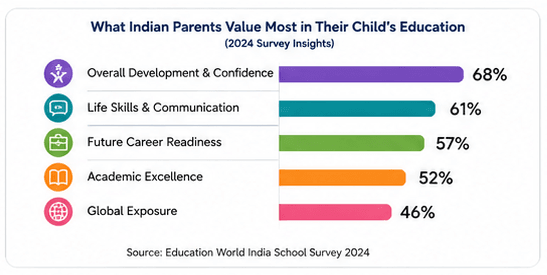
If the expectation is only syllabus completion and examination preparation, families may not fully experience the value of an inquiry-led international environment. But if parents want children to develop confidence, communication ability, independence, adaptability, research skills, leadership experiences, and long-term readiness for university and life beyond school, the equation begins to look very different.
At Bloomingdale International School, education is positioned not simply as academic delivery, but as a guided journey where children gradually discover how to think, communicate, collaborate, reflect, and grow into capable young adults prepared for a changing world. That is why the real conversation around IB schools is rarely about fees alone. It is about the kind of future a family is hoping to build for their child.
Must Read: What Parents Should Know Before Choosing IB?
Many parents today believe early learning shapes confidence, communication, emotional security, and curiosity. They often choose IB schools because of play-based inquiry, low-pressure learning, mentorship, and child-centred environments.
IB can be worth it for families looking beyond marks alone. The curriculum focuses strongly on independent thinking, communication, research ability, and future-ready skills that many universities and careers now value.
Success depends on the individual child, but IB students often develop confidence, adaptability, communication skills, and independent learning habits that help them adjust well in university and professional environments.
IB schools usually invest heavily in teacher training, international curriculum systems, mentorship programmes, student support, inquiry-based learning environments, sports, arts, and university counselling infrastructure.
CBSE often aligns more directly with Indian competitive examinations and structured theoretical preparation. Some families also prefer its familiarity, affordability, and syllabus continuity.
Yes. Many students switch from CBSE to IB successfully, especially during middle or secondary years. Students may initially need support adapting to inquiry-led learning, research, and independent classroom participation.
The conversation around IB schools is no longer only about fees. It is really about what kind of childhood, learning environment, and future preparation parents want for their children.