Galileo Campus
Bloomingdale International School Road PenamaluruEarly Years Village Campus
Municipal Employees Colony Main Road
Galileo Campus
Bloomingdale International School Road PenamaluruEarly Years Village Campus
Municipal Employees Colony Main Road
Share article:


Friday, June 12, 2026
by Bloomingdale International School
For years, the answer many families heard was discouraging. The common belief was that engineering and medical entrance examinations in India were designed almost entirely around CBSE and coaching-based preparation systems. International Baccalaureate curricula were often seen as suitable for foreign universities, liberal arts education, or broader academic exploration, but not for highly competitive Indian entrance pathways.
That perception is changing faster than many parents realise.
Today, IB students across India are successfully preparing for JEE, NEET, CUET, and other Indian competitive examinations while simultaneously keeping international university options open. The reason is not that the IB curriculum is easier. In fact, many students and educators would argue the opposite. The difference lies in how students learn, how they approach concepts, and how they build academic confidence over time.
At Bloomingdale International School, this conversation is approached carefully because parents are not simply asking about examinations. They are asking whether their child can remain academically competitive while still growing with confidence, curiosity, emotional balance, and long-term clarity about the future.
That is where the conversation around IB and Indian entrance exams becomes much more meaningful.
Most Indian parents grew up in educational systems built around memorisation, repetition, and examination performance. Naturally, when families hear terms such as inquiry-led learning, interdisciplinary education, reflection, or conceptual understanding, they sometimes worry whether children will remain competitive in high-pressure entrance examinations.
The concern is understandable.
According to the National Testing Agency (NTA), more than 14 lakh students appeared for JEE Main 2024, while NEET UG registrations exceeded 24 lakh. Competition is intense, and parents understandably want reassurance that their child will not miss opportunities due to curriculum choices.
At the same time, the pattern of these examinations has gradually evolved. Modern JEE and NEET papers increasingly test conceptual understanding, application-based reasoning, analytical problem-solving, and time management, rather than memorisation alone.
This shift is important because these are precisely the habits many IB students begin developing early through inquiry-led classrooms, research projects, analytical discussions, presentations, interdisciplinary learning, and independent academic exploration.
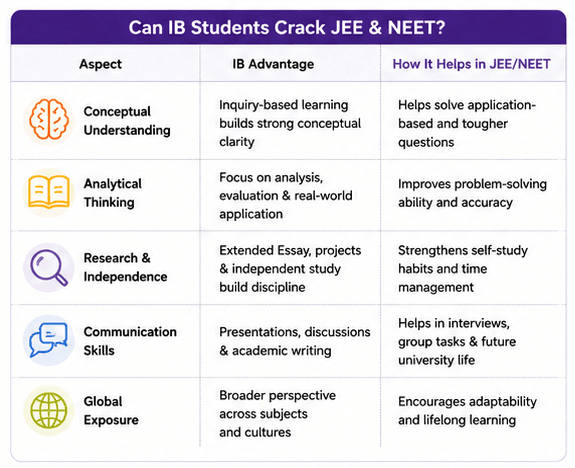
One of the most overlooked advantages IB students develop is intellectual flexibility. Students in the IB environment regularly move between conceptual discussions, analytical writing, scientific investigations, presentations, and research-based assignments.
As a result, many students become comfortable handling unfamiliar academic situations. This becomes extremely valuable during entrance preparation because JEE and NEET are ultimately examinations of pressure handling, conceptual clarity, and application speed.
Research from the Organisation for Economic Co-operation and Development (OECD) PISA Framework consistently shows that inquiry-based learning environments improve analytical reasoning and real-world problem-solving abilities. These are skills increasingly visible in modern engineering and medical entrance examinations.
This does not mean IB students can avoid disciplined preparation. They still require structured revision, numerical practice, mock examinations, speed-building, and familiarity with NCERT-oriented question patterns.
But students who already understand concepts deeply often adapt more naturally to application-heavy questions than students relying entirely on rote memorisation systems. That is why the conversation should never be framed as “IB versus JEE or NEET.” The more accurate conversation is, “How can students combine conceptual understanding with strategic entrance preparation?”
Must Read: Is an IB School Worth ₹4-5 Lakhs a Year?

Successful IB students preparing for JEE and NEET usually follow a balanced preparation strategy rather than treating school and entrance preparation as completely separate worlds. The strongest students typically begin aligning with NCERT concepts early while continuing to benefit from the broader strengths of the IB learning model.
For example, IB Physics and Mathematics often build strong analytical foundations that support JEE preparation. Similarly, IB Biology encourages conceptual clarity and scientific reasoning that can help students adapt well to NEET-style application questions. The strategy that works most effectively usually includes four important elements.
Students preparing for Indian entrance examinations benefit greatly from becoming familiar with NCERT textbooks and terminology early rather than waiting until Grade 12. This reduces panic-driven preparation later and allows students to build consistency gradually.
Most successful IB students combine school learning with focused external preparation for high-volume question solving, exam pacing, mock testing, and revision systems. The goal is not endless study hours. The goal is structured consistency over time.
One major strength that many IB students gradually develop is independent planning ability. The IB Diploma already includes Internal Assessments, Extended Essay work, research tasks, presentations, and interdisciplinary projects. Students, therefore, begin learning deadline management, prioritisation, independent scheduling, and academic discipline, which becomes extremely useful during competitive exam preparation.
Many students chase speed too early without fully understanding concepts. Strong IB students often build a deep understanding first and then improve speed through practice. This usually creates better retention and stronger adaptability during unfamiliar problem-solving situations.
A decade ago, many Indian families viewed engineering and medicine through very narrow definitions of success. Today, the landscape looks very different. Students preparing for JEE and NEET are also exploring biotechnology, AI and data science, healthcare innovation, neuroscience, interdisciplinary sciences, economics, global STEM pathways, and research-oriented careers.
Parents increasingly want flexibility alongside academic competitiveness. This is one reason many families today are drawn toward the IB Diploma. Students are able to prepare for Indian entrance examinations, apply to global universities, pursue interdisciplinary pathways, and shift academic directions more comfortably if their interests evolve later.
At Bloomingdale International School, engineering and medical aspirations are approached thoughtfully rather than fearfully. Students are encouraged to build strong conceptual foundations, strengthen analytical confidence, develop disciplined study habits, and maintain emotional balance throughout preparation.
Inquiry-led classrooms, project-based learning, reflective discussions, interdisciplinary exploration, and research-oriented learning help students build genuine understanding rather than surface-level memorisation alone.
At the same time, students pursuing competitive pathways receive guidance through academic mentoring, subject planning, pathway discussions, and preparation support aligned with long-term goals.
Because ultimately, success in JEE or NEET is not only about surviving an examination. It is about helping your child grow into a confident, resilient, intellectually capable young individual who can continue succeeding long after the examination itself is over.
Yes. IB students can crack NEET successfully when they combine conceptual learning with structured NCERT-based preparation, mock testing, and consistent revision strategies.
Yes. IB students are eligible for IIT admissions after qualifying through JEE Advanced and completing the required AIU equivalence procedures.
Yes. IITs accept IB students who meet JEE eligibility criteria and obtain equivalence certification from the Association of Indian Universities (AIU).
Yes. IB students can apply to Indian universities across engineering, medicine, business, law, economics, liberal arts, psychology, and design programmes after meeting eligibility requirements.